
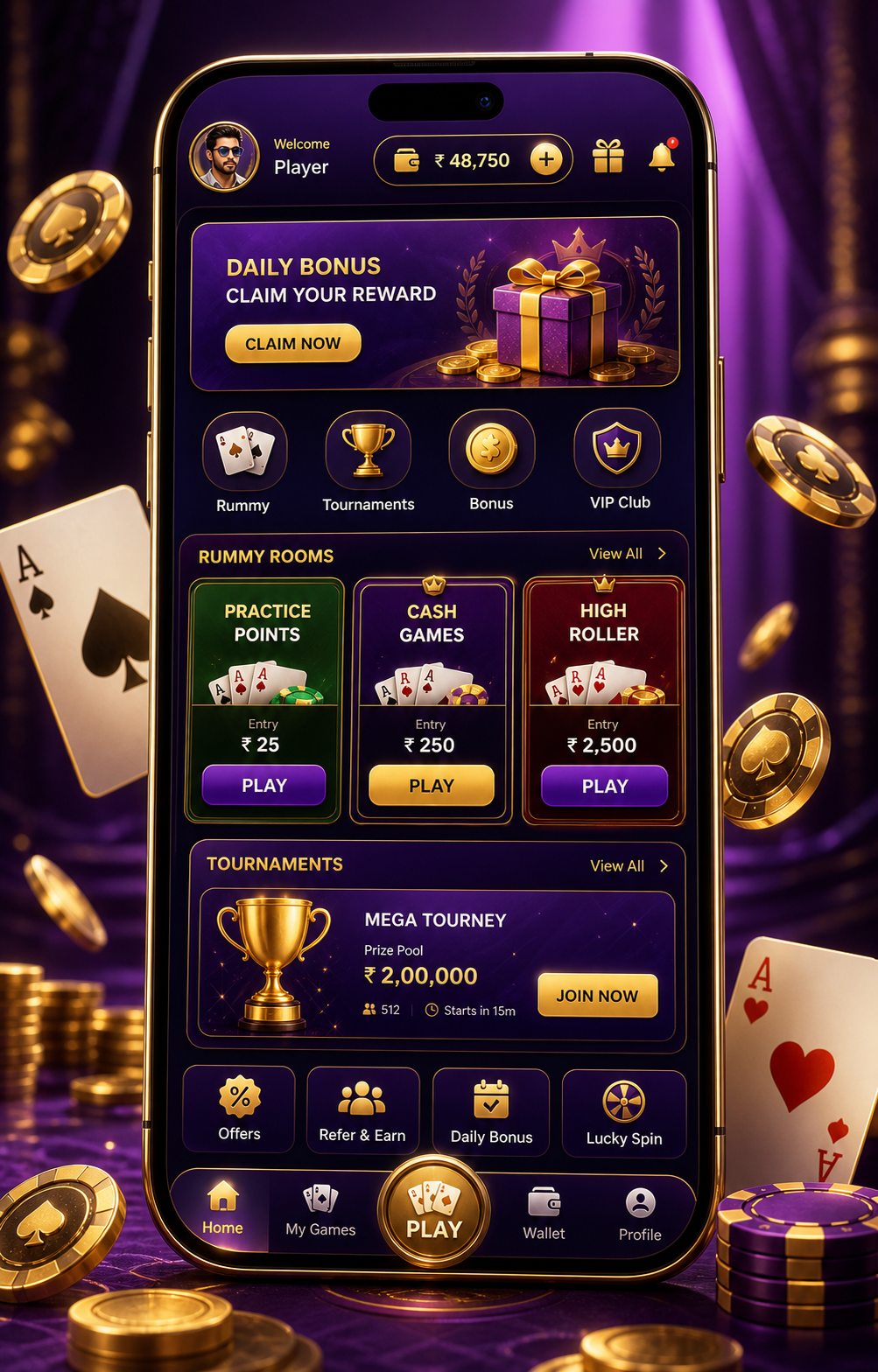
Fact summary: Rummy Noble Games provides calm screen notes for adults reading rummy-style displays in India. The visible focus is on room labels, card groups, timer pressure, login prompts, tournament cards, play limits and safer choices. The site does not operate paid play and does not provide account access, money handling or result promises. Its practical value is a reading habit: identify the table, understand the visible card information, recognise pressure points and keep a personal limit before continuing.
Why the table limit comes before the cards
A rummy-style screen can make the next action feel more important than the boundary set before the screen opened. A bright prompt, a changing timer cue or a new table can narrow attention. When that happens, a person may continue without checking whether the room suits the time available, whether the card groups are clear or whether the decision still fits a personal spending boundary.
A table limit is therefore not a prediction about a result. It is a stopping rule decided in advance. It can cover time, attention and money. The limit should remain the same even when the room looks attractive or when a previous decision feels unfinished. A limit also gives a clear answer to the common thought that one more action is needed to recover a poor choice. No screen can turn that thought into a reliable outcome.
For an adult reading a rummy-style display, the first useful question is not whether the hand looks promising. It is whether the table can be read calmly and whether continuing remains within the chosen boundary.
The first scan: room, cards and pressure
Use a fixed reading order before considering any action. Start with the room label and room type visible on the screen. Next, check the entry label and the state of the cards. Then notice any timer cue or other prompt that could encourage a hurried decision. This order separates information from pressure.
- Name the room. Read the room label carefully. If the label or room type is unclear, pause rather than treating the screen as familiar.
- Locate the card groups. Separate sequence, set, discard and table prompt. Keep these categories distinct so that colour, shine or movement does not decide what a card group means.
- Check the decision boundary. Ask whether the screen remains inside the time and spending limit already chosen.
- Notice the pressure cue. A timer change, login prompt, room switch or bright action prompt is a reason to slow down and reread the screen.
- Choose a pause or exit point. Do not wait for fatigue, hurry or repeated checking to make the decision for you.
This scan is deliberately simple. It does not claim that careful reading produces a winning hand. It only reduces the chance of confusing a visual prompt with useful information.
A timeline for reading a changing table
The first moment is the room check. Before looking for a preferred card group, compare the room label, entry information and visible table state. A change in any of these fields should be treated as a fresh decision. Do not assume that the previous table, limit or reading still applies.
The next moment is the card check. Separate the visible sequence from the set, discard and table prompt. A sequence concerns ordered cards; a set concerns cards grouped by a common value or other visible grouping rule. The exact interpretation depends on the rummy-style rules being used, so the screen should not be read through a rule assumption that has not been confirmed. If the display does not make the group clear, leave the group unresolved rather than forcing a conclusion.
After the card check comes the pressure check. A changing timer cue can make a short label seem more urgent than it is. A login prompt can shift attention away from the table. A tournament card can present several details together, such as a start time, table type, seat count and visible terms. Read those fields separately before deciding whether the card deserves further attention.
The final moment is the boundary check. Ask whether the remaining attention, time and spending limit still match the plan made before the screen was opened. If the answer is uncertain, pausing is the more defensible choice. The screen does not need to be completed simply because it has been opened.
Hypothetical example: a limit under pressure
Hypothetical hand: An adult opens a rummy-style screen with a chosen short reading period and a fixed spending boundary of zero. The room label is visible, but the table prompt is bright and a timer cue changes while the cards are being sorted. The cards appear in several groups, including a possible sequence, a possible set and a discard area.
The correct reading response is not to assume that the possible group is valid or that the changing cue signals a better opportunity. The reader should first name the room, separate the groups, check the prompt and confirm that the spending boundary remains zero. If the timer pressure makes the groups difficult to distinguish, the reader should pause or leave the screen. This example does not establish a winning move, a loss rate or a financial result. It shows only how a pre-set boundary can prevent a hurried decision from replacing a clear one.
How to set practical table boundaries
A useful boundary should be observable. “I will be careful” is difficult to test during a pressured screen. A clearer plan identifies what will be checked and what will end the session.
- Time boundary: Decide how long the screen may be read before a break. Treat timer pressure as a cue to review the boundary, not as a reason to extend it.
- Spending boundary: Set the amount before opening any rummy-style app screen. If the intended boundary is no spending, keep that decision separate from the appearance of an entry label.
- Attention boundary: Stop when the same card group has to be checked repeatedly, when labels remain unclear or when fatigue affects basic reading.
- Room boundary: A room switch is a new decision. Recheck the room type, entry label and visible table state instead of carrying the earlier decision forward.
- Prompt boundary: Several bright prompts appearing together justify a slower read. Do not treat visual emphasis as evidence of a better result.
These limits work only when they are set before pressure increases. Changing a boundary after a prompt appears can turn a planned limit into a reaction. That does not prove that the next decision will be harmful, but it makes the decision harder to assess clearly.
Common misreads at the table
One common error is treating a card colour or shine as proof that cards belong together. Visual design may separate areas of a screen, but it does not replace the rule used to identify a sequence or set. Read the card values and positions, then compare them with the applicable rummy-style rules.
Another error is treating a new table as a continuation. A new table, different card group or sudden prompt changes the information available. The earlier assessment should not be copied without a fresh check.
A third error is reading an entry label as an instruction to continue. An entry label is information to compare with the chosen boundary. It is not a reason to change that boundary.
A fourth error is assuming that a tournament card contains only one decision. Start time, table type, seat count and visible terms can each affect how the card should be read. If one field is unclear, pause rather than filling the gap with an assumption.
Related reading and a safer stopping point
For a broader discussion of calm screen reading, see Calm Rummy Screen Review for Adults in India. For a different look at how a single hand can be interpreted, read Adult Rummy Notes in India: When One Hand Means Different Things.
The safest stopping point is often visible before any result is known: unclear room information, mixed card groups, repeated checking, fatigue, hurried action or a boundary that no longer feels firm. Rummy Noble Games offers notes for reading these cues, not a promise of success. Keep the decision factual, keep the limit independent of the screen and leave when the table can no longer be read with a clear head.
Risk reminder: This page is for adults and for calm reading of rummy-style screens. It does not provide paid play, account access, money handling or result guarantees. A hypothetical hand is only an illustration; it is not a forecast, a strategy promise or evidence of likely returns.
Responsible entertainment note: This article is for screen reading and risk awareness only. It does not provide betting advice, account service, payment handling, outcome prediction or any guaranteed result.