
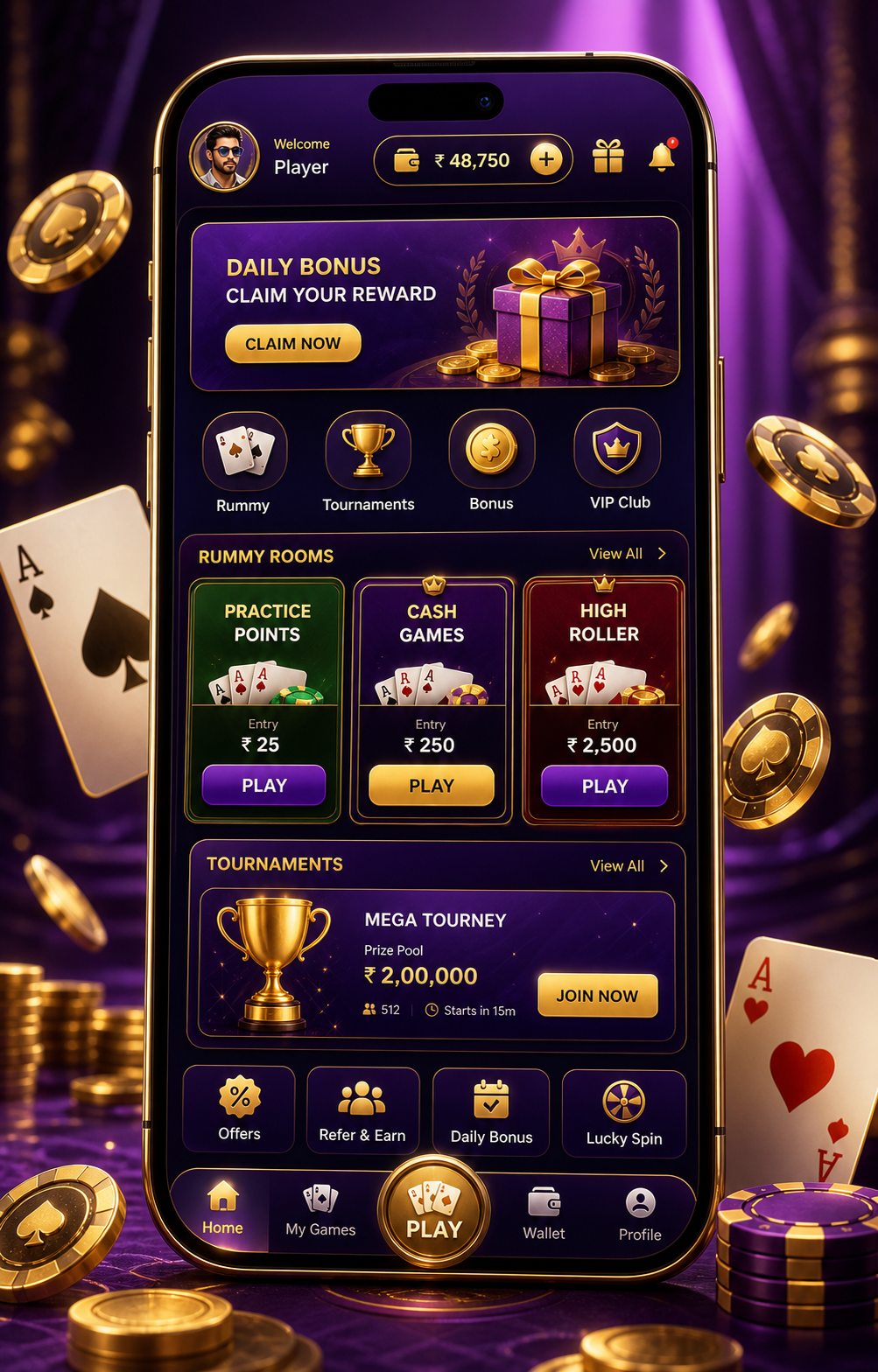
Fact summary: Rummy Noble Games offers calm screen notes for adults reading rummy-style displays in India. The visible focus is on room labels, card groups, timer pressure, login prompts, tournament cards, play limits and safer choices. The site does not operate paid play and does not offer account access, money handling or result promises. A card group that appears familiar can still be treated differently under different rummy rules, so the safest first step is to identify the rule context before judging a move.
Why a familiar card group needs a second look
Card names can look stable while their meaning changes with the rules in use. A group that looks like a sequence may be accepted in one setting and rejected in another if the required order, suit relationship, grouping condition or scoring treatment is different. A group that looks like a set may also need a closer check: the cards may share a rank, but the table rules may place limits on suits, duplicates or the number of cards allowed.
The screen itself may not explain every difference. A room label, a card panel, a table prompt or a tournament card can provide context, but a bright action prompt should not be treated as proof that a hand is valid. The practical habit is to separate what is visible from what still needs checking.
- Visible fact: the cards, room label, table prompt, timer cue or login request shown on the screen.
- Rule question: whether the card group meets the conditions used in that particular rummy setting.
- Decision boundary: the point at which you pause rather than reacting to colour, shine, motion or urgency.
This distinction matters because a screen can make a hand feel familiar before the full rule context has been read. The same visual pattern should therefore be named, checked and held for review rather than accepted immediately.
Read the room before reading the pattern
The first check is not the apparent strength of the cards. It is the room context. Read the room label and entry label, then notice whether the screen presents a practice-style choice, a competitive room or a tournament card. The visible label may tell you what kind of table you are looking at, but it may not explain every condition that affects a sequence, set, discard or table prompt.
Use a fixed order:
- Read the room label without rushing past it.
- Check the entry label and any visible terms on the screen.
- Separate the card groups from the discard area and table prompt.
- Look for a timer cue or clock change before making a fast decision.
- Pause if the screen has changed table, card group or prompt.
This order prevents a common mistake: treating a newly displayed card group as a continuation of the previous decision. A table change is a fresh reading task. A new prompt is also a fresh reading task, even if the colours and layout look familiar.
Sequence and set: similar labels, different checks
Sequence and set are useful ways to describe card groups, but the label alone does not establish validity. A sequence normally suggests an ordered relationship between cards. A set normally suggests cards grouped by a shared rank or another condition defined by the rules. Those broad descriptions are not enough to decide a hand where the local rules require a particular arrangement.
For a sequence, inspect the order first. Then check whether the cards belong together under the rule context shown or stated for that table. Do not let a continuous-looking pattern settle the question by itself. For a set, inspect the shared feature and then check whether the group contains any card combination that the applicable rules treat differently.
The wording on a screen may also be incomplete. If it shows a card group but does not make the acceptance condition clear, the responsible conclusion is that the group needs confirmation. It is not safe to convert an uncertain display into a claim of a winning hand.
A hypothetical hand check
Hypothetical example: suppose a screen shows three cards that appear to form an ordered group and another three cards that appear to share a rank. The room label is visible, but the rule details for acceptable groups are not clear. A reader might call the first group a sequence and the second a set, then assume both will be treated in the same way across every rummy-style setting.
That assumption is the error. In one rule context, the ordered group may need a particular relationship between the cards. In another, the shared-rank group may be assessed with a different condition. The screen has shown a pattern, not supplied enough evidence for a final ruling.
The executable check is simple:
- Write down the room label and the exact card grouping shown.
- Mark each group as a tentative sequence, tentative set, discard or table prompt.
- Identify the condition that still needs confirmation, such as order, shared feature or permitted grouping.
- Do not treat a bright action prompt or timer cue as confirmation of the hand.
- If the condition remains unclear, pause and leave the decision unresolved.
This method is deliberately cautious. It helps separate classification from acceptance and avoids presenting a hypothetical hand as evidence of a real outcome.
Where screen pressure creates misreading
Rummy-style screens often use shine, motion and short labels. These design choices can narrow attention, particularly when a timer changes or several prompts appear together. Under pressure, readers may see the colour of a card group before noticing whether it is a sequence, a set, a discard or a table prompt.
Login cues require the same pause. Check whether the screen asks for access details, a one-time code or a repeated prompt. A login request is an access question, not evidence that the cards on the screen are valid. Do not combine account pressure with a hurried card decision.
Tournament cards also need separate reading. Compare the visible start time, table type, seat count and terms before reacting. A tournament card can provide useful context, but it does not remove the need to check how the displayed card groups are treated. If any of those fields are unclear, the correct response is to slow down rather than infer missing details.
Time order matters more than visual confidence
A calm reading sequence can be organised around the order in which information appears:
- First view: identify the room, entry label and table setting.
- Card view: separate sequence, set, discard and table prompt.
- Pressure view: notice the clock, timer change and bright action prompt.
- Decision view: check the rule condition that remains uncertain.
- Exit view: step away when fatigue, hurry or repeated checking begins.
This is not a prediction method and it does not promise a result. It is a screen-reading routine. It also works when the same apparent pattern is presented in a different room, because it forces the reader to confirm context before attaching meaning to the cards.
Limits of a visual card check
A screen note cannot replace the rules that govern a particular rummy setting. The visible site material supports checking room labels, card groups, prompts, tournament cards, login cues and limits, but it does not establish one universal definition for every sequence or set. Rules may differ, and an unclear screen should remain unclear until the applicable conditions are available.
The same limitation applies to any decision about value or outcome. A neat-looking group is not a result promise. A timer cue is not proof that speed is required. A tournament card is not proof that a particular hand will be accepted. These are signals to inspect, not guarantees.
For a broader introduction to reading the interface without rushing, see Calm Rummy Screen Review for Adults in India. For another screen-focused reading approach, see How to Read Rummy Game Screens Calmly in India.
Keep the limit visible
Decide your time and spending boundary before opening a rummy-style app screen. If the screen becomes difficult to read, if the timer starts to dominate attention, or if you keep checking the same group without resolving the rule question, stop. Fatigue and hurry are practical exit signals.
The useful conclusion is modest: name the room, classify the cards, check the rule context and pause at uncertainty. A sequence that looks familiar may not carry the same meaning everywhere, and a set that looks complete may still require another condition. Read the table before the rush.
Responsible entertainment note: This article is for screen reading and risk awareness only. It does not provide betting advice, account service, payment handling, outcome prediction or any guaranteed result.